Dental Tip Tuesday: Is Your Practice Overhead Eating Your Profit?
Is Your Practice Overhead Eating Your Profit?
Running a dental practice is expensive. Payroll, rent, supplies, lab fees, marketing, software, insurance, utilities, and daily operational costs can quietly stack up before you realize how much profit is slipping away.
That is why overhead benchmarks matter.
They are not meant to shame a practice owner or create panic. They are meant to give you a clear financial snapshot of where your money is going — and where your practice may need attention.
What Is Dental Practice Overhead?
Overhead is the percentage of practice revenue used to operate the business before owner compensation and profit.
In simple terms:
Revenue comes in. Overhead goes out. Profit is what remains.
When overhead is too high, the practice may still look busy on the schedule but feel financially tight behind the scenes. That is one of the most frustrating positions for a dental owner: working hard, producing dentistry, leading a team, and still wondering why the numbers do not reflect the effort.
Healthy Dental Practice Overhead Benchmark
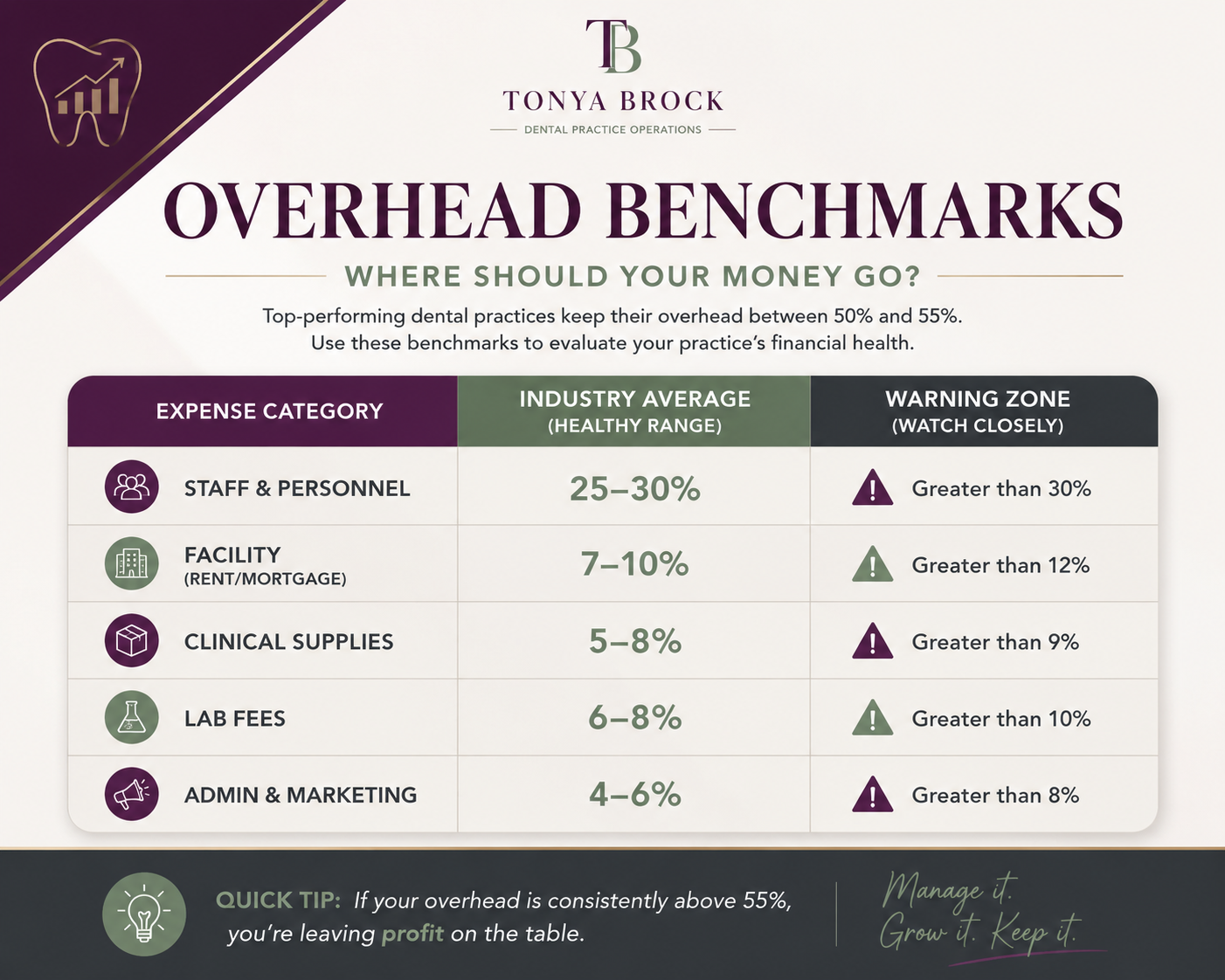
Top-performing dental practices typically keep total overhead between:
50%–55%
When overhead consistently rises above 55%, it may be a sign that the practice is leaving profit on the table.
That does not always mean there is one major problem. More often, it means several small leaks are happening at the same time.
A little overspending in supplies.
A little inefficiency in scheduling.
A little imbalance in payroll.
A little missed opportunity in collections.
A little too much going out before the practice owner ever sees the return.
Those small leaks add up.
Key Overhead Benchmarks to Watch
1. Staff & Personnel: 25%–30%
Payroll is usually one of the largest expenses in a dental practice.
A healthy range is typically 25%–30% of revenue.
If staff and personnel expenses are greater than 30%, it may be time to review scheduling, role clarity, overtime, cross-training, and whether the team structure supports the current production level.
This does not automatically mean you are overstaffed. It may mean the practice needs better systems, better scheduling flow, or clearer accountability.
2. Facility Costs: 7%–10%
Facility expenses include rent or mortgage costs.
A healthy range is typically 7%–10%.
If facility costs are greater than 12%, the practice may need to look closely at revenue per operatory, schedule utilization, and whether the space is producing enough to support its fixed cost.
You cannot always change rent, but you can often improve how effectively the space is being used.
3. Clinical Supplies: 5%–8%
Clinical supplies should typically fall between 5%–8% of revenue.
If supplies are greater than 9%, it may be time to review ordering systems, vendor pricing, inventory control, supply waste, and whether the team has a consistent process for tracking usage.
A strong supply system protects both the budget and the clinical flow.
4. Lab Fees: 6%–8%
Lab fees commonly fall between 6%–8%.
If lab costs are greater than 10%, the practice may need to review procedure mix, case acceptance, lab partnerships, remakes, fee schedules, and treatment planning communication.
High lab fees are not always bad if they are connected to strong production and profitable case acceptance. The key is making sure the numbers are aligned.
5. Admin & Marketing: 4%–6%
Admin and marketing costs are often overlooked because they are spread across many small expenses.
A healthy range is typically 4%–6%.
If this category is greater than 8%, review software subscriptions, unused systems, advertising ROI, duplicate tools, and whether marketing efforts are actually converting into scheduled patients.
Marketing should not just create attention. It should create measurable practice growth.
Why These Numbers Matter
The goal is not to cut everything.
The goal is to understand what is working, what is wasteful, and what needs to be adjusted.
A healthy practice is not built by guessing. It is built by reviewing the numbers, identifying patterns, and making intentional decisions.
When your overhead is controlled, your practice has more room for:
Better team support
Stronger systems
Improved patient experience
Owner compensation
Growth planning
Peace of mind
Quick Tip
If your overhead is consistently above 55%, your practice may be leaving profit on the table.
That does not mean the practice is failing. It means the practice is ready for a closer look.
Sometimes the biggest financial improvements come from cleaning up the systems already inside the business.
Need a Clearer Picture of Your Practice Health?
If you are unsure where your practice stands, start with a simple review of your overhead categories.
Look at payroll, facility costs, supplies, lab fees, admin expenses, marketing, collections, scheduling, and production flow.
Numbers tell a story.
The right systems help you rewrite it.
T Brock Dental Ops helps dental practices identify operational leaks, improve systems, and scale with more clarity and less chaos.
Grow your practice. Keep your peace.