Dental Tip Tuesday: Staffing Is Not Just a Payroll Problem
There has been a lot of conversation lately about staffing in dental practices.
Hiring is hard. Retention is hard. Training takes time. And many practice owners are exhausted from trying to keep the schedule full, the team engaged, and the day moving without constant disruption.
But here is the operational truth:
Staffing is not just a payroll problem.
It is a systems problem.
A great team can still struggle inside a practice that does not have clear roles, consistent expectations, strong communication, and repeatable workflows. When systems are weak, even talented people begin to feel overwhelmed, unsupported, or disconnected from the bigger picture.
That is when staffing starts to feel expensive.
Not because the team is not valuable.
But because the practice is not getting the full return on the talent already in the building.
What staffing benchmarks can tell you
Healthy staffing is not only about how many people are on payroll. It is about whether the team is structured to support the practice’s growth.
A few key areas to watch:
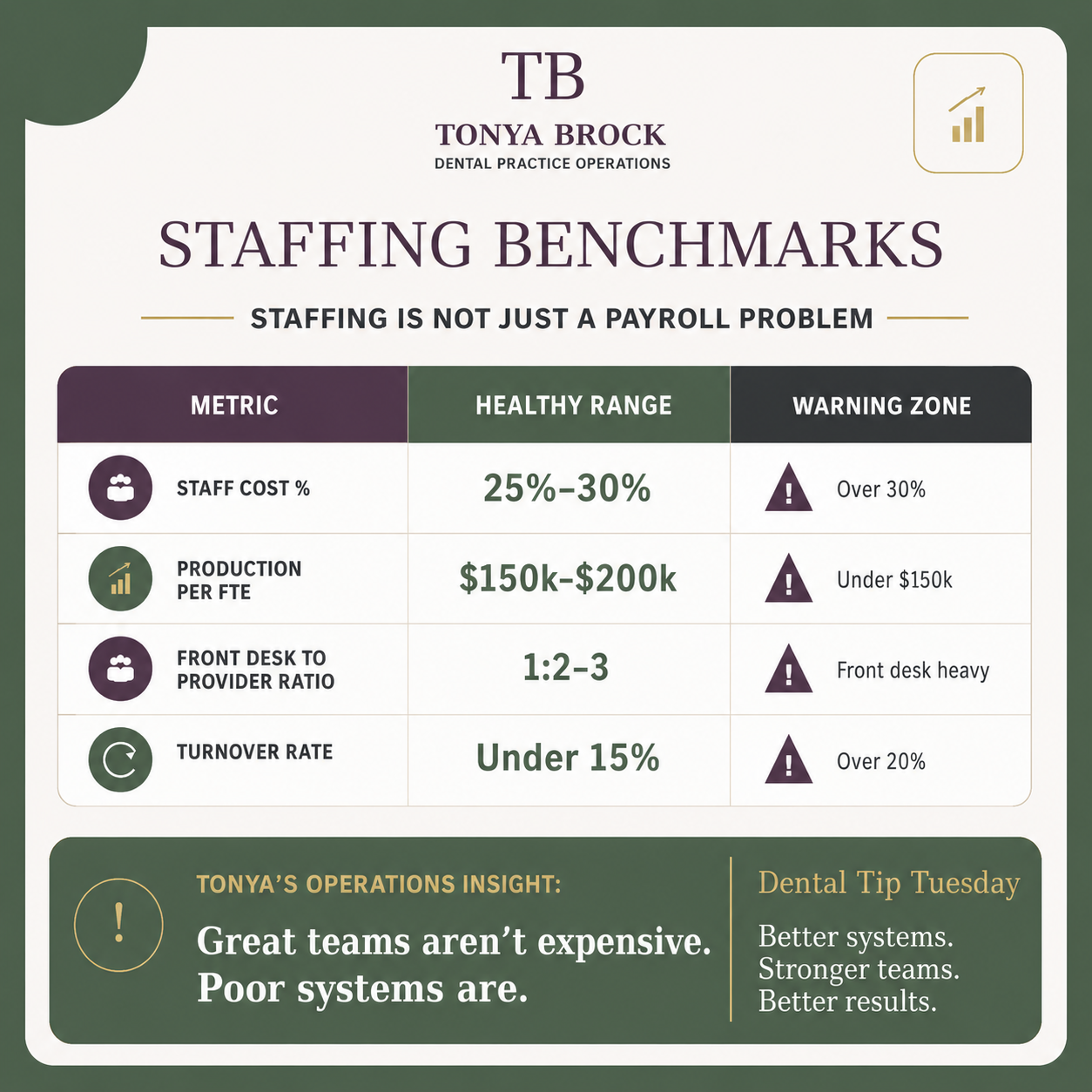
Staff cost percentage
A healthy staffing range is often around 25%–30%. When staff cost climbs above that, the answer is not always to cut hours or reduce people. The better question is whether the team has the systems, training, and accountability needed to produce efficiently.
Production per full-time employee
A healthy range is often around $150k–$200k per FTE. If production per team member is low, the practice may be overstaffed, undertrained, under-scheduled, or losing opportunities through poor handoffs and unclear ownership.
Front desk to provider ratio
A healthy front desk-to-provider ratio is usually around 1:2–3. Too little front office support can create bottlenecks. Too much support without clear responsibility can create confusion, overlap, and missed accountability.
Turnover rate
Turnover under 15% is a strong indicator of stability. When turnover rises, it is worth looking deeper. People may leave because of pay, but they also leave because of chaos, unclear expectations, lack of leadership, poor communication, or feeling like they cannot win.
Great teams are not expensive. Poor systems are.
A strong team is one of the greatest assets a dental practice can have.
But even a great team needs structure.
They need to know:
Who owns each task.
What the standard is.
When follow-up happens.
How success is measured.
Where to go when something breaks down.
What matters most each day.
Without that structure, the team may stay busy all day without actually moving the practice forward.
That is when the doctor feels frustrated.
The team feels overwhelmed.
The schedule feels reactive.
And payroll starts to feel heavier than it should.
This week’s Dental Tip Tuesday
Before assuming you have a staffing problem, look at your systems.
Ask yourself:
Are roles clearly defined?
Are expectations written down?
Is the team trained consistently?
Are daily priorities clear?
Is accountability calm and consistent?
Are the right people doing the right work?
Do team members understand how their role supports production, collections, and patient care?
Staffing problems do not always mean you need more people.
Sometimes they mean the practice needs better structure around the people it already has.
A peaceful, productive practice is not built by payroll alone.
It is built by people supported by systems that work.
If staffing feels heavy, chaotic, or expensive in your practice, it may be time to look deeper.
Take the Practice Scorecard to see where your practice may be losing time, production, or peace.