Unscheduled Treatment - How much diagnosed treatment is sitting untouched ?
Every day, dental practices diagnose treatment that never gets scheduled.
Not because patients always say “no.”
More often, they get busy, forget, become overwhelmed, or simply never receive a meaningful follow-up.
Over time, those unscheduled treatment plans become one of the largest sources of hidden revenue loss in a practice.
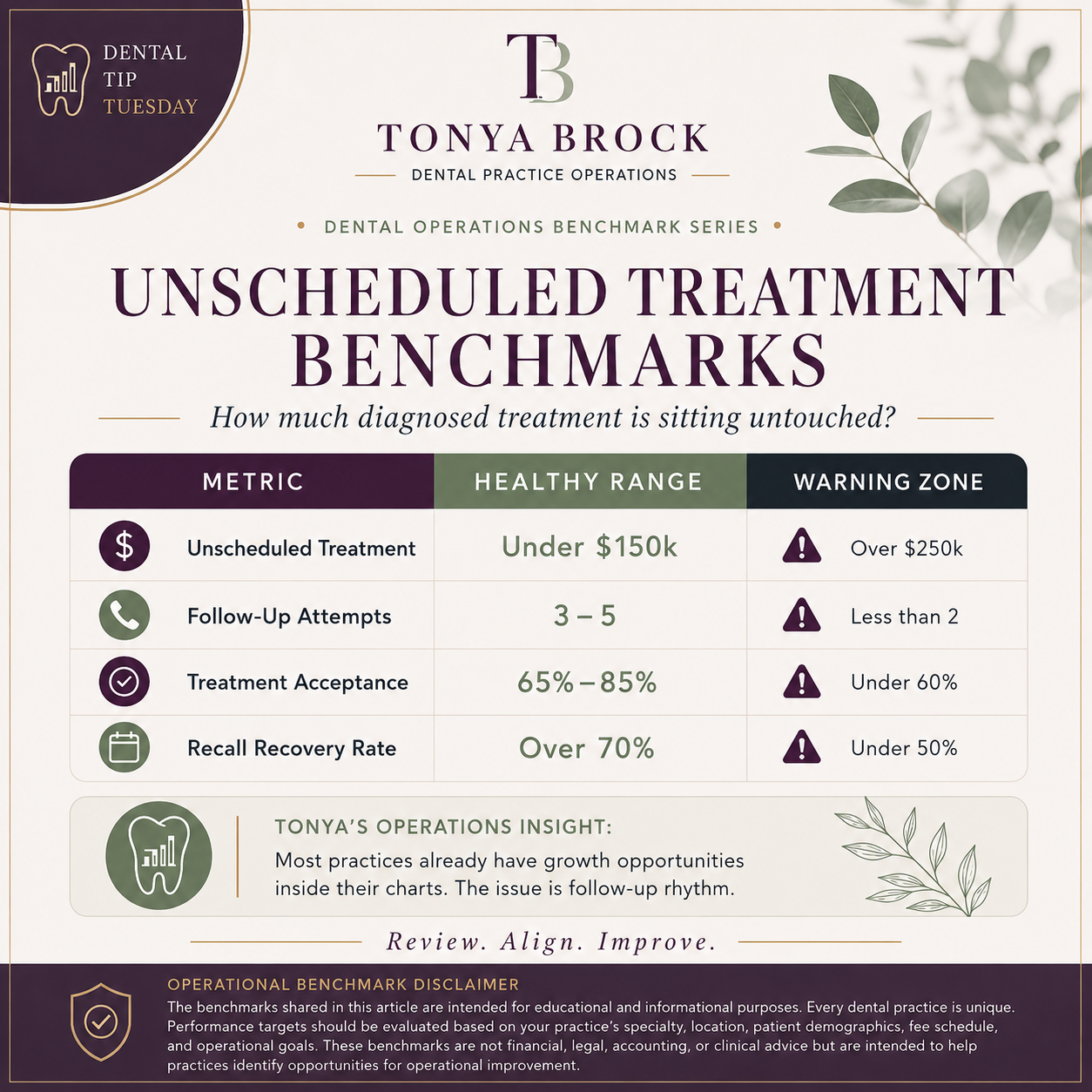
Unscheduled Treatment
This is the total dollar amount of diagnosed treatment that has not been scheduled. When this number grows, it usually means the practice has opportunities sitting inside existing charts. The issue may not be diagnosis. It may be follow-up, financial conversations, scheduling access, or unclear patient communication.
Healthy range: Under $150k
Warning zone: Over $250k
Follow-Up Attempts
One reminder is rarely enough.
Patients get busy. They forget details. They may need time to review finances or talk with a spouse. A healthy follow-up system uses multiple touchpoints without making patients feel pressured.
Healthy range: 3-5 documented attempts
Warning zone: Less than 2 attempts
Treatment Acceptance
Treatment acceptance measures how many patients move forward with diagnosed care.
Low acceptance can point to gaps in education, trust, financing options, handoffs, urgency, or presentation clarity. It is not just a doctor issue. It is an operations issue.
Healthy range: 65%-85%
Warning zone: Under 60%
Recall Recovery Rate
Recall recovery tracks how effectively the practice brings overdue patients back into care.
This matters because overdue recall patients often have existing unscheduled treatment or developing needs. Strong recall recovery keeps the patient relationship active and protects long-term production.
Healthy range: Over 70%
Warning zone: Under 50%
Tonya’s Operations Insight
One of my favorite sayings is:
Most practices don’t have a production problem. They have a follow-up problem.
Patients rarely wake up thinking about unfinished crowns, implant treatment, or periodontal therapy.
It’s the practice’s responsibility to create a consistent process that keeps treatment top of mind without making patients feel pressured.
✔️Operational consistency builds trust.
✔️Trust builds acceptance.
✔️Acceptance improves patient health while strengthening the practice.
If your practice has hundreds of thousands of dollars in unscheduled treatment, your next growth opportunity may already be sitting inside your software.
You don’t always need more new patients.
Sometimes you simply need a better system for reconnecting with the ones you’ve already helped.
The T Brock Benchmark Standard
Every benchmark published in the T Brock Dental Operations Benchmark Series is rooted in more than 30 years of real-world dental operations experience and informed by commonly observed performance trends across private practices.
No two practices are identical. Specialty, provider mix, payer mix, geographic location, technology, fee schedules, leadership style, and business goals all influence what healthy performance looks like.
These benchmarks are designed to provide operational insight, encourage meaningful evaluation, and help practices reveal opportunities for improvement. They are educational in nature and should not be interpreted as financial, legal, accounting, regulatory, or clinical advice, nor should they replace an individualized assessment of your practice.
At T Brock Dental Operations, I believe benchmarks should do more than measure. They should identify opportunities, strengthen systems, empower teams, and support sustainable growth without sacrificing what matters most.
Review. Align. Improve.

Wondering how your practice compares?
Take the complimentary Practice Scorecard for a quick snapshot of your operational health and identify opportunities to strengthen production, consistency, and patient care.