Your Schedule Should Work Harder Than You Do
Last week, we looked at staffing benchmarks and why staffing pressure is not always just a payroll problem.The conversations from that created a wide range of questions about the strategy I build with and how help Providers be less stressed. Thank you for all of your inquiries.
This week, we are moving one layer deeper.
Because sometimes what feels like a staffing issue is actually a scheduling issue.
When the schedule is not structured well, the entire team feels it. The front desk feels it in the phones, confirmations, last-minute changes, and patient flow. The clinical team feels it in rushed handoffs, uneven room flow, and days that swing between overloaded and underfilled. Providers feel it when production does not match effort. Patients feel it when the day runs behind, communication feels rushed, or treatment opportunities are missed.
A strong schedule is not just a list of appointments.
It is an operational system.
The Schedule Sets the Pace of the Practice
In many dental offices, the schedule becomes the quiet driver of the day. When it is built intentionally, it supports production, patient experience, team flow, and provider focus.
When it is not, the team spends the day reacting.
That reaction can look like:
Running behind before lunch
Hygiene columns sitting underutilized
Same-day treatment opportunities being missed
Front desk overload from last-minute changes
Providers jumping between rooms without clear flow
The team feeling busy without the numbers reflecting it
This is where staffing and scheduling connect.
A practice may think it needs more people, but the deeper question is whether the schedule is supporting the people already there.
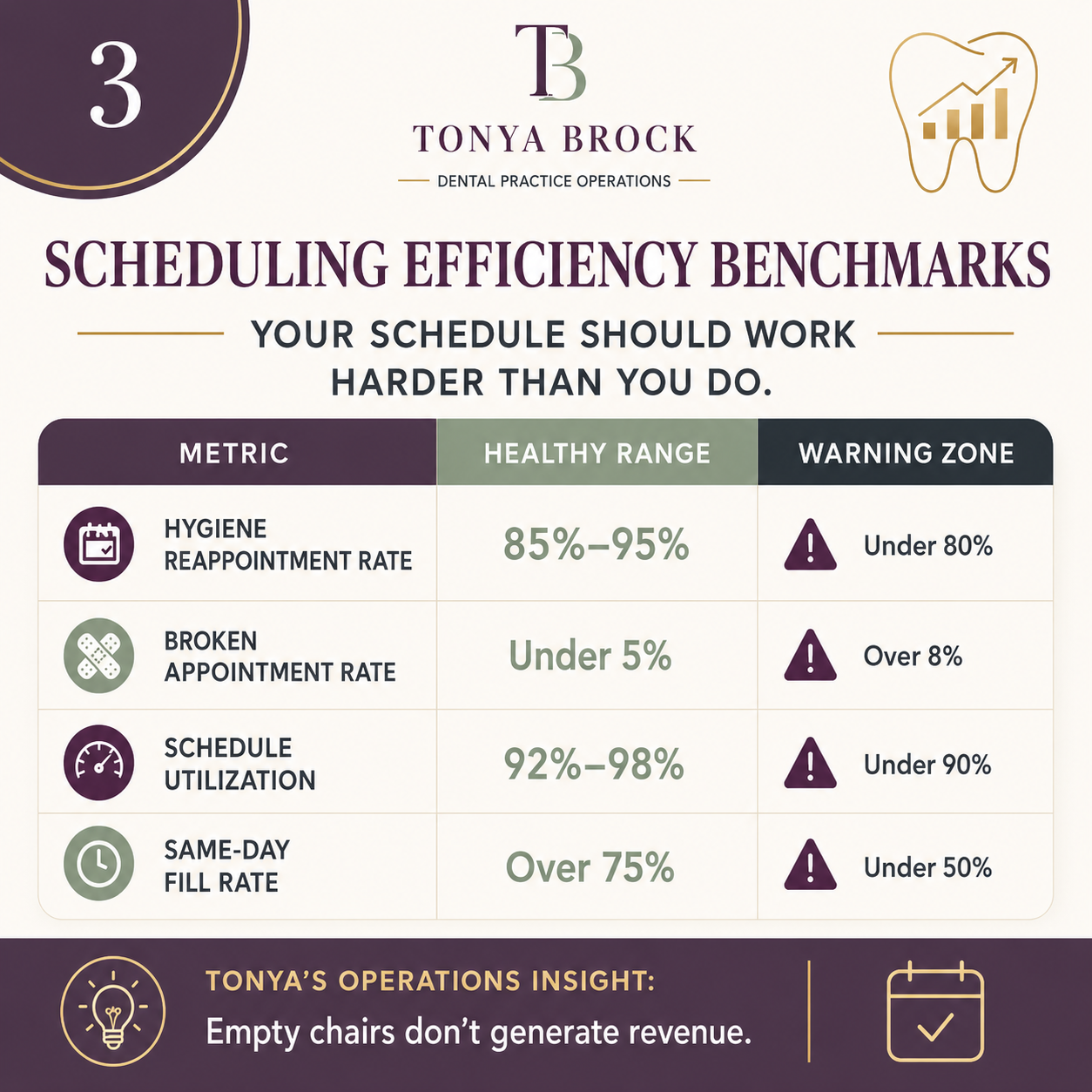
Key Scheduling Benchmarks to Watch
Every practice is different, but there are a few scheduling indicators that can quickly show whether the day is working with the team or against them.
1. Hygiene Appointment Rate
A healthy hygiene appointment rate usually sits around 85%–95%.
When hygiene is consistently below that range, it may point to weak recall systems, inconsistent patient follow-up, broken confirmation processes, or underused hygiene capacity.
Hygiene is not just a department. It is one of the strongest engines for patient retention, treatment diagnosis, and long-term practice stability.
When hygiene is not protected, the whole practice eventually feels it.
2. Broken Appointment Rate
A strong target is usually under 5%.
Broken appointments do more than create holes in the schedule. They disrupt production, reduce team confidence, and create unnecessary scrambling throughout the day.
If broken appointments are happening often, the issue may not be the patients alone. It may be confirmation timing, unclear cancellation expectations, weak value-building, poor financial communication, or a schedule that does not have a recovery plan.
The goal is not just to fill holes.
The goal is to understand why the holes are happening.
3. Schedule Utilization
A healthy schedule utilization rate is usually around 92%–98%.
This looks at how much available provider and hygiene time is actually being used productively.
A schedule can look full and still be inefficient. It may be filled with low-value appointments in prime production time, uneven appointment lengths, poor procedure mix, or gaps that are too small to use and too large to ignore.
A full schedule is not always a healthy schedule.
The right schedule should support production, patient care, and team pace at the same time.
4. Same-Day Fill Rate
A strong same-day fill rate is typically over 75%.
Every practice has cancellations. The question is whether the team has a system to recover from them.
A same-day fill process should be clear, simple, and owned by the right person. The team should know who to call, what type of appointment fits, which patients are ready, and how quickly action needs to happen.
Without that structure, the team wastes valuable time trying to make decisions in the middle of an already moving day.
Scheduling Problems Often Hide as Staffing Problems
This is where many practices get stuck.
The team feels overwhelmed, so the first thought is, “We need more help.”
Sometimes that is true.
But before adding another person, it is worth asking:
Is the schedule balanced?
Are hygiene columns being used well?
Are providers scheduled according to procedure type and pace?
Are emergency visits placed intentionally?
Is there a clear process for cancellations?
Are same-day treatment opportunities being identified?
Is the front desk carrying preventable chaos?
If those answers are unclear, adding another team member may only give the chaos another chair to sit in.
Better scheduling design can reduce pressure before payroll increases.
What a Healthier Schedule Creates
When scheduling systems are working, the practice usually feels different.
The team is not guessing all day. The front office knows where the openings are, which patients to contact, and what type of appointment belongs where. The clinical team has better flow. Providers have fewer bottlenecks. Patients receive more consistent communication.
Most importantly, the practice can grow without the team feeling like every day is being held together with tape and caffeine.
A strong schedule creates:
Better production flow
Better provider rhythm
Stronger hygiene retention
Fewer avoidable gaps
Better patient experience
Less stress on the front desk
More predictable days for the whole team
Scheduling is not just an admin task.
It is one of the most important operational systems in the practice.
Tonya’s Operations Insight
Empty chairs do not generate revenue.
But a poorly designed schedule can cost more than an empty chair because it drains time, energy, trust, and team capacity.
Before assuming the practice needs more people, look at whether the current schedule is helping the team succeed.
The schedule should not run the practice.
The practice should run the schedule.
Final Thought
Staffing benchmarks tell us whether the team structure is healthy.
Scheduling benchmarks help us see whether the day-to-day flow is supporting that team.
When both are reviewed together, the practice gets a clearer picture of what is actually happening beneath the surface.
Better schedules create better days.
Better days create stronger teams.
Stronger teams create better patient care.
And that is where real operational growth begins.

If your practice is feeling the pressure of a full schedule, broken appointments, hygiene gaps, or a team that feels busy without seeing the results, it may be time to look beneath the surface.
T Brock Dental Operations helps dental practices identify workflow bottlenecks, strengthen scheduling systems, and create operational structure that supports both the team and the patient experience.