Case Acceptance
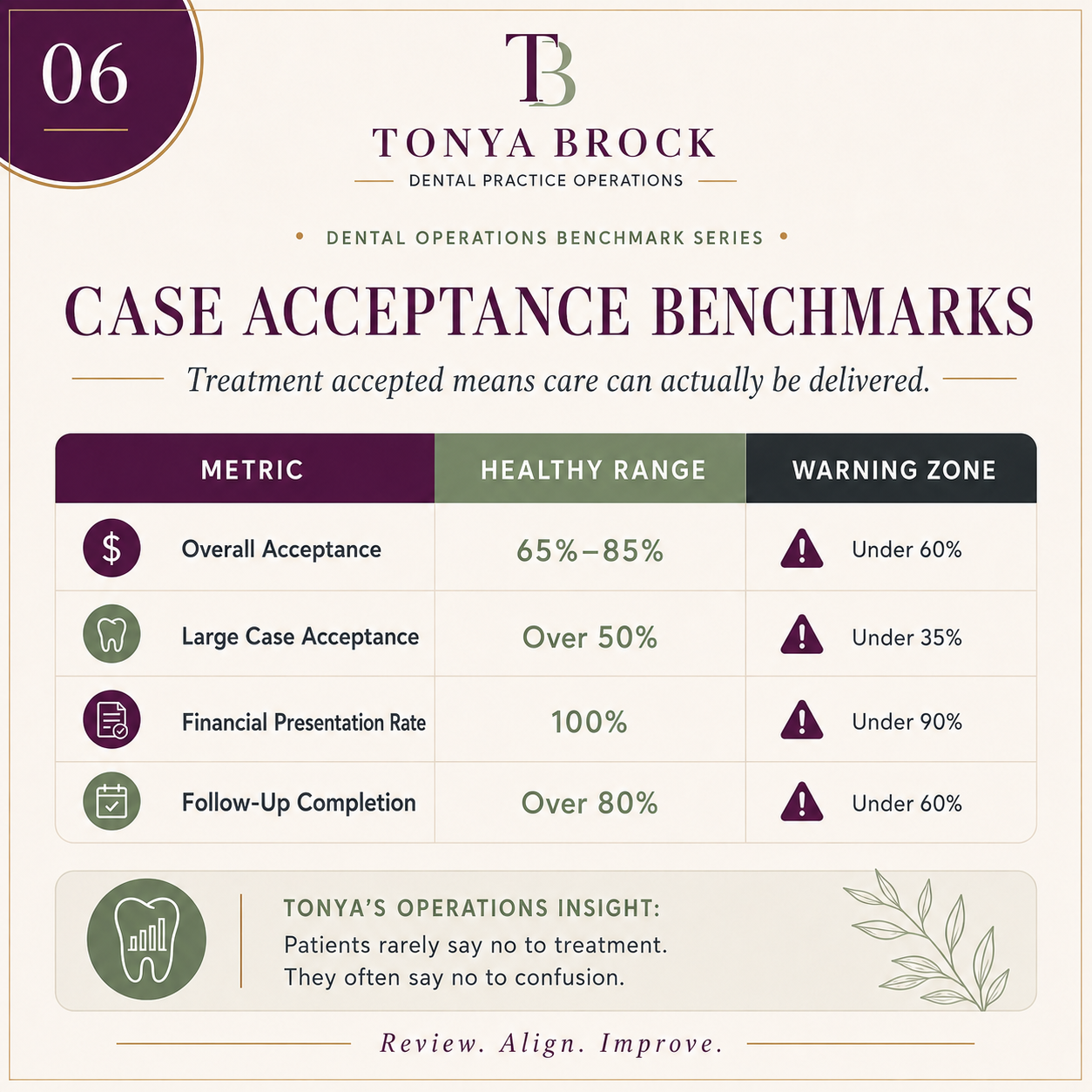
Case Acceptance: Treatment accepted means care can actually be delivered.
Every dental practice invests time, energy, and resources into diagnosing patient needs and presenting treatment options.
But diagnosis alone doesn’t improve oral health.
Acceptance does.
A beautifully planned treatment case has no impact if it never moves forward.
That’s why case acceptance is one of the most important operational indicators inside a practice. It reflects communication, trust, financial clarity, follow-up systems, and the overall patient experience.
When acceptance rates begin to decline, practices often assume the issue is pricing.
In reality, the problem is frequently much deeper.
Patients rarely say no to treatment.
They often say no to confusion.
Healthy Case Acceptance Benchmarks
Overall Case Acceptance
Healthy Range: 65% - 85%
Warning Zone: Under 60%
Strong practices consistently help patients understand the value of treatment and feel confident moving forward.
Large Case Acceptance
Healthy Range: Over 50%
Warning Zone: Under 35%
Comprehensive treatment plans require trust, education, financial coordination, and consistent follow-up.
When large case acceptance declines, it is often a sign that one of these systems needs attention.
Financial Presentation Rate
Healthy Range: 100%
Warning Zone: Under 90%
Every diagnosed treatment plan should receive a clear financial presentation.
Patients cannot make informed decisions if costs, insurance estimates, or payment options are unclear.
Follow-Up Completion
Healthy Range: Over 80%
Warning Zone: Under 60%
Many patients need time to consider treatment.
The practices that consistently follow up often see dramatically higher acceptance rates than those that rely on a single conversation.
Common Causes of Low Case Acceptance
When acceptance rates begin to slip, practices should evaluate:
Treatment presentation consistency
Financial communication
Insurance estimate accuracy
Follow-up systems
Scheduling availability
Patient trust and education
Team confidence during case presentation
Improving case acceptance rarely requires pressure.
It requires clarity.
Tonya’s Operations Insight
For more than three decades, I’ve watched practices focus heavily on production goals while overlooking the systems that help patients move forward with care.
The strongest practices don’t “sell” treatment.
They create understanding.
They build trust.
They remove obstacles.
And they follow through.
When those systems are in place, acceptance becomes a natural outcome rather than a constant struggle.
Patients rarely say no to treatment.
They often say no to confusion.
Final Thoughts
This concludes the Dental Operations Benchmark Series.
Over the past several weeks, we’ve explored the operational metrics that influence practice performance, team accountability, patient experience, and sustainable growth.
Benchmarks aren’t intended to create pressure.
They’re intended to create awareness.
Every practice has opportunities.
Every practice has strengths.
And every practice deserves operational systems that support both profitability and peace.
Grow your practice. Keep your peace.
T Brock Dental Operations
Review. Align. Improve.

Ready to Learn More?
If you’re curious about how your practice compares across key operational areas, start with the complimentary Practice Scorecard.
The scorecard provides a quick snapshot of operational strengths, gaps, and opportunities for improvement.