Insurance Verification & Claims Readiness
A reliable insurance-verification and claims-readiness system should achieve:
Verification completion: 100% of scheduled insured appointments
Timing: Before treatment; ideally two to three business days before scheduled care
Documentation: Source, date, time, plan details, and confirmation retained
Patient communication: Estimated responsibility reviewed before treatment
Claims readiness: Required documentation identified before submission
Exception ownership: Zero unresolved discrepancies without an owner and next action
Performance review: Verification-related denials, delays, and estimate variances reviewed monthly
These are operational control targets rather than promises of payer accuracy or payment.
Final Thought
Insurance verification is not a clerical task performed for the payer.
It is a patient-communication system, a scheduling safeguard, and a revenue-cycle control for the practice.
When verification is completed thoroughly and early, the team is better prepared.
Treatment estimates are clearer.
Patients experience fewer financial surprises.
Claims leave the practice cleaner.
Follow-up becomes more focused.
And leadership gains a clearer view of where preventable revenue-cycle problems begin.
The claim may be processed after treatment.
But claims readiness begins before the patient is seated.
Benchmark Methodology Disclaimer: The benchmarks in this article are operational control targets intended for education and strategic planning. Dental benefit information is not a guarantee of coverage or payment. Plan information, payer requirements, contracts, state rules, treatment circumstances, and patient eligibility may change. Practices should follow applicable payer agreements, laws, regulations, and professional guidance.
Prepared by: Tonya Brock, Fractional Operations Executive
T Brock Dental Operations
Primary references:
American Dental Association: Eligibility Verification
American Dental Association: Pre-Authorizations and Predeterminations
American Dental Association: Dental Claim Form and Completion Resources
Benchmark Image Copy
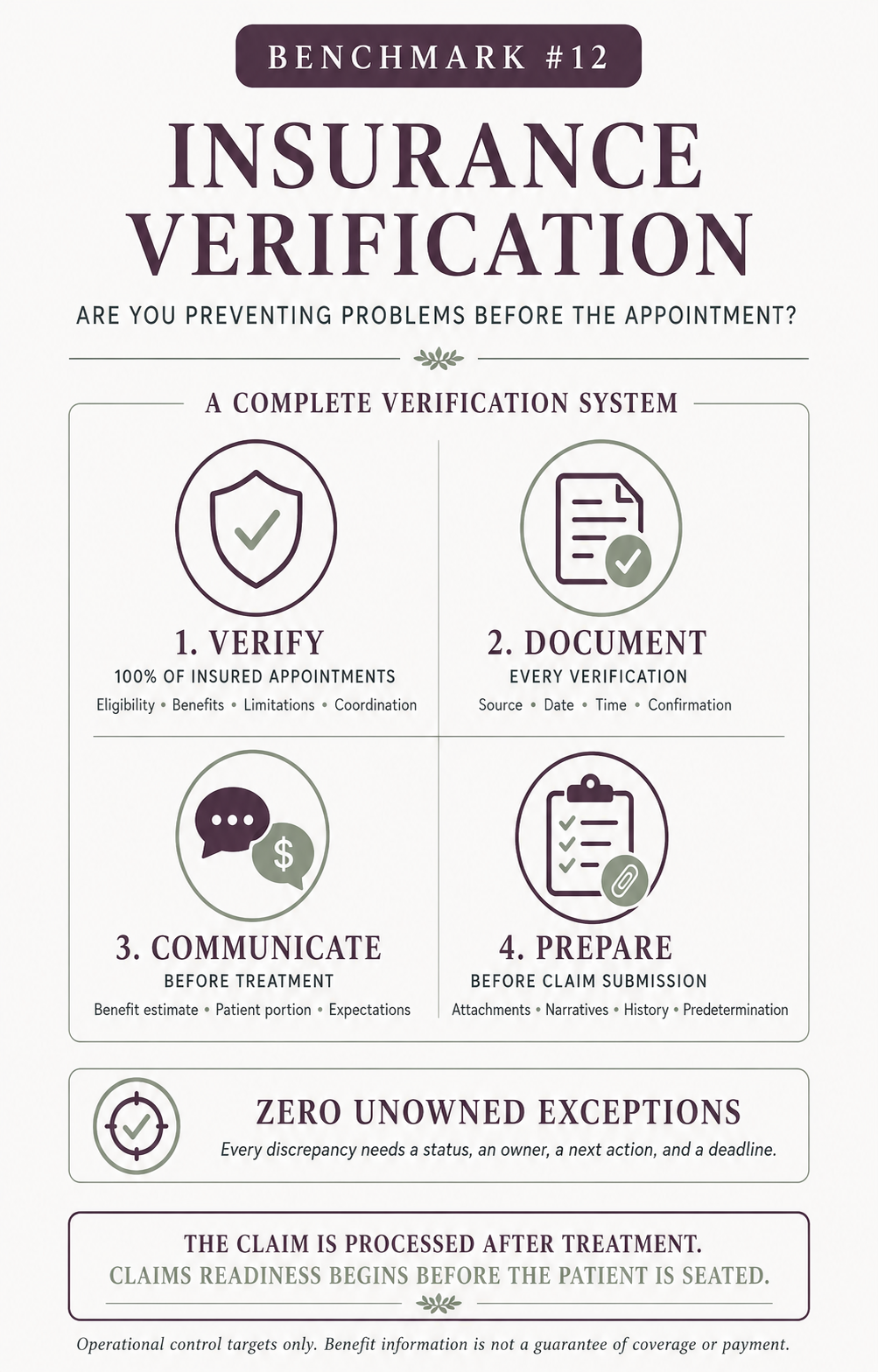
BENCHMARK #12
INSURANCE VERIFICATION
ARE YOU PREVENTING PROBLEMS BEFORE THE APPOINTMENT?
A COMPLETE VERIFICATION SYSTEM
1. VERIFY
100% OF INSURED APPOINTMENTS
Eligibility, remaining maximum, deductible, coverage, limitations, and coordination of benefits
2. DOCUMENT
EVERY VERIFICATION
Source, date, time, representative, confirmation, and plan details
3. COMMUNICATE
BEFORE TREATMENT
Estimated insurance benefit, estimated patient portion, and financial expectations
4. PREPARE
BEFORE CLAIM SUBMISSION
Required attachments, narratives, history, and predetermination information
ZERO UNOWNED EXCEPTIONS
Every discrepancy needs a status, an owner, a next action, and a deadline.
THE CLAIM IS PROCESSED AFTER TREATMENT.
CLAIMS READINESS BEGINS BEFORE THE PATIENT IS SEATED Operational control targets only. Benefit information is not a guarantee of coverage or payment.
Are You Preventing Problems Before the Appointment?
Many insurance problems appear after treatment.
The claim is delayed.
An attachment is missing.
A frequency limitation was overlooked.
The deductible was not included in the estimate.
The patient receives a larger balance than expected.
The team begins making phone calls, correcting claims, explaining balances, and trying to reconstruct what was known before the appointment.
But many of those problems did not begin when the claim was submitted.
They began before the patient was seated.
Insurance verification is one of the most important front-end controls in the dental revenue cycle. When the process is thorough, timely, documented, and connected to the treatment plan, the practice is better prepared to submit clean claims and communicate financial expectations clearly.
When it becomes a rushed check for “active coverage,” the practice may create preventable work for both the team and the patient.
Active Coverage Is Only the Beginning
Confirming that a patient is eligible on the date of service matters.
But eligibility alone does not tell the practice:
Whether the deductible has been met
How much of the annual maximum remains
Whether a procedure is subject to a frequency limitation
Whether a waiting period applies
Whether the plan has a missing-tooth clause
Whether the plan substitutes a lower-cost benefit
Whether replacement limitations affect coverage
Whether periodontal history changes the available benefit
Whether coordination of benefits is required
Whether a predetermination or preauthorization is recommended or required
Whether clinical documentation or radiographs will be needed with the claim
A patient can have active coverage and still have little or no available benefit for the treatment being discussed.
That is why a complete verification process must look beyond eligibility.
Verification Completion
Operational target: 100% of scheduled patients using dental benefits have verification completed before treatment.
Verification should be completed early enough for the team to resolve discrepancies, request missing information, update the treatment estimate, and communicate with the patient before the appointment.
For most scheduled care, a practical internal standard is to complete verification at least two to three business days before the visit. More time may be needed for extensive treatment, multiple plans, unusual plan requirements, or cases requiring predetermination.
Same-day emergencies require a different workflow, but they should not require no workflow.
The benchmark is not perfection from the payer.
The benchmark is that every insured appointment has a defined verification status:
Complete
Pending payer response
Missing patient information
Coverage discrepancy
Predetermination pending
Escalated for review
Verification Documentation
Operational target: 100% of verifications include the source, date, time, and supporting details.
The American Dental Association recommends documenting verification interactions because information provided through a payer portal or call center may not always be current or complete.
Documentation should include:
Date and time the information was obtained
Payer portal, electronic response, fax, or telephone source
Name or identification number of the payer representative, when applicable
Screenshot or saved electronic response when appropriate
Effective date
Patient and policyholder information
Group and member identification numbers
Plan type and network status
Remaining annual maximum
Remaining deductible
Coverage percentages by service category
Frequency and age limitations
Waiting periods
Replacement limitations
Missing-tooth clause
Alternate-benefit or downgrade provisions
Coordination-of-benefits information
Predetermination or preauthorization requirements
Relevant reference or confirmation numbers
If a team member cannot tell where the information came from or when it was obtained, the verification cannot be defended or reliably updated.
Good documentation creates continuity.
The person presenting treatment, collecting payment, submitting the claim, and following the account should all be working from the same information.
Patient Financial Communication
Operational target: 100% of treatment estimates are reviewed with the patient before treatment begins.
Verification is not complete when the information is placed in the software.
It is complete when the information supports a clear financial conversation.
Patients should understand:
The practice fee
The estimated insurance benefit
The estimated patient portion
The payment expected before or on the date of service
Any benefit limitation that may affect the estimate
Whether a predetermination is pending
That insurance information is an estimate, not a guarantee of payment
That the patient remains responsible for amounts not paid by the plan, according to the practice’s financial policy and applicable contracts
The language matters.
The team should not say:
“Your insurance will pay this.”
A more accurate explanation is:
“Based on the information provided by your plan today, we estimate your benefit to be approximately this amount. Your plan will make the final determination when the claim is processed.”
That wording is transparent without making the patient feel abandoned to the insurance process.
It protects trust by separating what the practice knows from what the payer ultimately decides.
Claims Readiness
Operational target: required claim information and supporting documentation are identified before the claim reaches the submission queue.
Claims readiness begins during verification and treatment planning—not after the claim is rejected or returned.
Before treatment or claim submission, the practice should know whether the payer may require:
Current radiographs
Periodontal charting
Clinical narratives
Intraoral photographs
Tooth numbers and surfaces
Dates of prior placement
Dates of extraction
Prior treatment history
Coordination-of-benefits information
Primary explanation of benefits
Predetermination or preauthorization reference numbers
Documentation of medical necessity when applicable
A clean claim is not simply a claim that was transmitted.
It is a claim that was reviewed for accuracy, completeness, and payer-specific requirements before submission.
The stronger the front-end preparation, the less time the back office spends repairing preventable omissions.
Exception Ownership
Operational target: zero unresolved verification exceptions without an assigned owner and next action.
Every practice will encounter incomplete information.
The operational issue is not that an exception exists.
The issue is that it sits in the schedule without clear ownership.
Examples include:
The payer portal is unavailable
The patient submitted an outdated card
The policyholder’s information does not match
Coverage appears terminated
The remaining maximum conflicts with prior records
The patient has two plans and the primary payer is unclear
A predetermination has not been returned
The carrier cannot confirm a limitation
Every exception should have:
A documented status
An assigned team member
A specific next action
A deadline
A communication plan for the patient
An unresolved issue can be managed.
An invisible issue cannot.
Track the Problems Verification Should Prevent
Practices should review more than the number of verifications completed.
They should also track the downstream consequences of incomplete or inaccurate verification:
Claims delayed for missing information
Claims returned for missing attachments
Eligibility-related denials
Frequency-related denials
Coordination-of-benefits delays
Patient estimate variances
Unexpected patient balances
Verification-related adjustments or write-offs
Accounts requiring rework
Staff hours spent correcting preventable errors
This closes the loop between Benchmark #11 and Benchmark #12.
Benchmark #11 asked why dollars were adjusted or written off.
Benchmark #12 asks whether a front-end process could have prevented the confusion, delay, or loss.
Not every denial or variance is preventable.
Payer information may be incomplete. Coverage may change. Other claims may process before the practice’s claim. A predetermination may differ from the final benefit.
But the practice should still be able to demonstrate that it followed a consistent process, documented the information received, communicated the estimate responsibly, and responded to discrepancies promptly.
Build a Reliable Verification Workflow
A strong workflow includes:
1. Collect
Obtain complete patient, policyholder, employer, and plan information when the appointment is scheduled.
2. Verify
Review eligibility, benefits, limitations, history, coordination requirements, and remaining benefits before the visit.
3. Document
Record the source, date, time, representative, plan details, and supporting confirmation.
4. Estimate
Connect verified benefits to the treatment plan and calculate the estimated patient portion.
5. Communicate
Review the estimate and financial expectations with the patient before treatment.
6. Prepare
Identify required documentation, attachments, and predetermination needs before claim submission.
7. Track
Assign ownership to discrepancies and review verification-related denials, delays, and estimate variances.
A reliable insurance-verification and claims-readiness system should achieve:
Verification completion: 100% of scheduled insured appointments
Timing: Before treatment; ideally two to three business days before scheduled care
Documentation: Source, date, time, plan details, and confirmation retained
Patient communication: Estimated responsibility reviewed before treatment
Claims readiness: Required documentation identified before submission
Exception ownership: Zero unresolved discrepancies without an owner and next action
Performance review: Verification-related denials, delays, and estimate variances reviewed monthly
These are operational control targets rather than promises of payer accuracy or payment.
Final Thought
Insurance verification is not a clerical task performed for the payer.
It is a patient-communication system, a scheduling safeguard, and a revenue-cycle control for the practice.
When verification is completed thoroughly and early, the team is better prepared.
Treatment estimates are clearer.
Patients experience fewer financial surprises.
Claims leave the practice cleaner.
Follow-up becomes more focused.
And leadership gains a clearer view of where preventable revenue-cycle problems begin.
The claim may be processed after treatment.
But claims readiness begins before the patient is seated.
Benchmark Methodology Disclaimer: The benchmarks in this article are operational control targets intended for education and strategic planning. Dental benefit information is not a guarantee of coverage or payment. Plan information, payer requirements, contracts, state rules, treatment circumstances, and patient eligibility may change. Practices should follow applicable payer agreements, laws, regulations, and professional guidance.
Prepared by: Tonya Brock, Fractional Operations Executive
T Brock Dental Operations
Primary references: