Insurance Adjustments & Write-Offs
What Is Your Practice Actually Keeping?
Production can look impressive on a monthly report.
But production alone does not tell you what the practice was entitled to collect—or what ultimately reached the bank.
Between the practice's standard fees and actual collections sits an important financial category that deserves much more attention:
Adjustments and write-offs.
Some are legitimate and expected.
Others may reveal posting errors, inconsistent policies, incorrect insurance adjustments, unnecessary discounts, unresolved balances, or revenue that quietly disappeared without sufficient review.
The objective is not to eliminate adjustments.
The objective is to understand them.
A financially healthy practice should be able to explain the difference between what it produced, what it was contractually allowed to collect, what it actually collected, and why the remaining dollars were adjusted or written off.
If those numbers cannot be reconciled, the practice has a visibility problem.
Gross Production Is Not Collectible Production
One of the most important distinctions in dental-practice financial reporting is the difference between gross production and adjusted—or billable—production.
Gross production represents services produced according to the practice's established fee schedule.
Adjusted production reflects what remains collectible after legitimate adjustments, including contractual insurance obligations.
Collections represent what the practice actually received.
Those three numbers should not be treated interchangeably.
Consider a simplified example:
A practice's fee for a procedure is $1,500.
The contracted PPO allowable fee is $1,000.
The $500 difference is a contractual adjustment. The practice was never contractually entitled to collect that amount from the patient.
The remaining $1,000 is billable production.
If the practice ultimately collects only $950 of that $1,000, the remaining $50 represents something entirely different.
That $50 deserves an explanation.
This distinction is critical because a large insurance adjustment is not automatically evidence of poor collections.
But an unexplained reduction in collectible revenue may be.
1. Separate Contractual Adjustments From Other Write-Offs
Every adjustment should have a reason.
At minimum, practices should distinguish among categories such as:
PPO contractual adjustments
Courtesy or professional discounts
Employee or family discounts
Charity or donated dentistry
Administrative corrections
Refunds or credits
Provider-authorized write-offs
Bad debt
Small-balance write-offs
Collection-agency adjustments
Other approved financial adjustments
These categories should not be combined into one generic adjustment code.
When everything is labeled simply "adjustment" or "write-off," leadership loses the ability to determine why revenue changed.
Clear adjustment categories create financial visibility.
2. Monitor the Difference Between Gross and Adjusted Production
Practices participating with PPO plans should expect a difference between their standard fees and contracted allowable fees.
But that difference should still be measured.
Track:
Gross Production – Contractual Adjustments = Adjusted Production
Then review contractual adjustments by:
Insurance plan
Provider
Procedure category
Month
Location, when applicable
This does not mean every PPO adjustment represents preventable loss.
It means the practice should understand the financial effect of its payer mix.
If one plan consistently produces significant contractual reductions while creating administrative burden, delayed claims, or poor reimbursement, leadership should at least have the data necessary to evaluate that relationship intelligently.
3. Measure Collections Against What Was Actually Collectible
A practice can create a misleading collection percentage when gross production is used as the denominator in an insurance-heavy practice.
The more useful operational question is:
Of the money we were actually entitled to collect, how much did we collect?
The ADA has historically identified approximately 98% of adjusted or billable production as a strong collections benchmark.
That distinction matters.
A practice with substantial PPO participation may never collect 98% of gross production because contractual adjustments make part of that gross amount uncollectible by design.
The appropriate comparison is:
Collections ÷ Adjusted Production × 100
If the resulting percentage is consistently low, the problem is no longer simply insurance participation.
It may indicate weaknesses in:
Patient collections
Insurance follow-up
Claim submission
Denial management
Balance follow-up
Financial policies
Payment posting
Account ownership
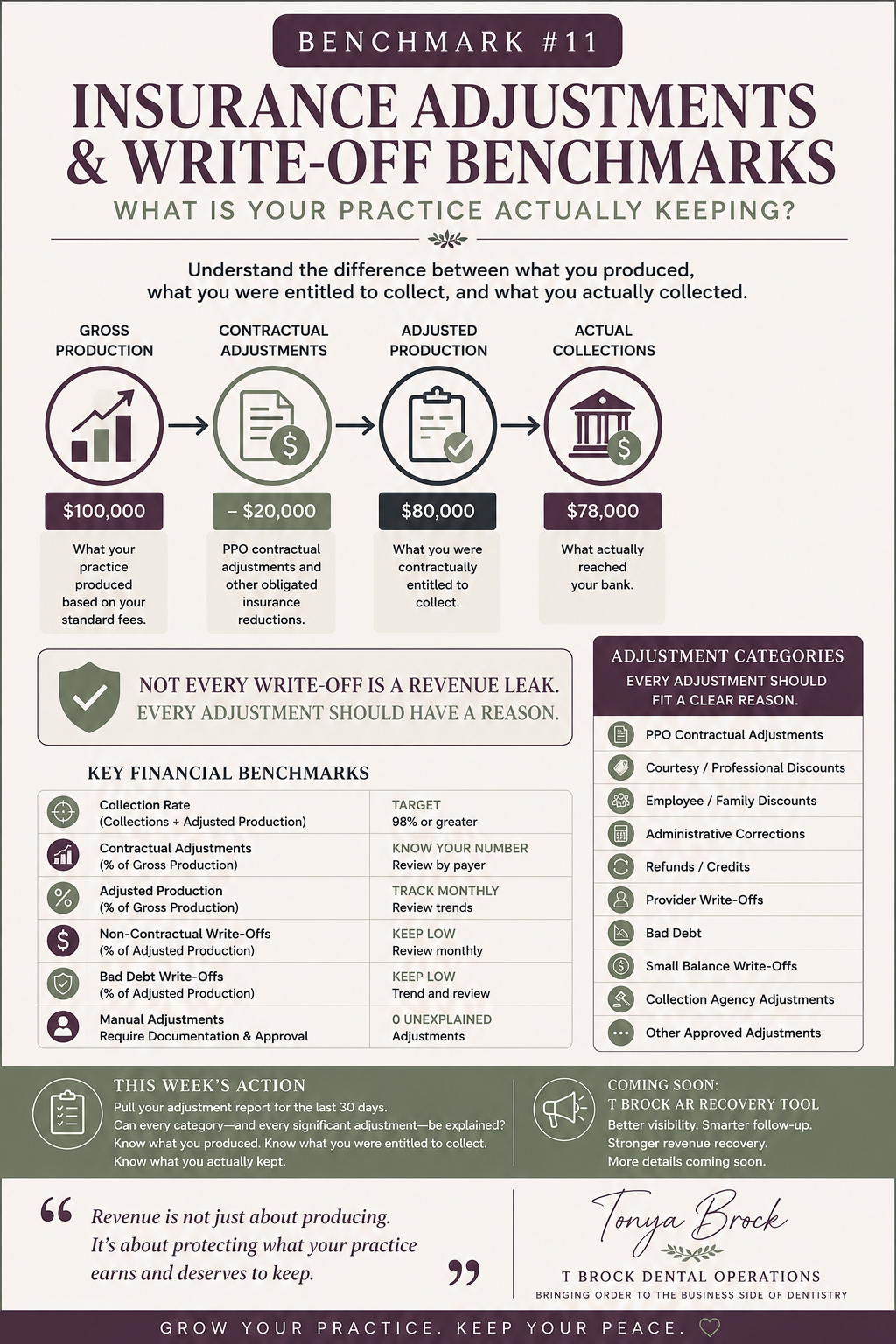
The Zero Balance Blueprint : How Insurance adjustments and Write-Offs Actually Work
4. Review Non-Contractual Write-Offs Separately
Contractual adjustments are one thing.
Discretionary or unexplained write-offs are another.
Leadership should know how much revenue is being removed through:
Courtesy discounts
Provider adjustments
Staff adjustments
Bad debt
Small-balance write-offs
Administrative corrections
Unresolved patient balances
The question is not whether these adjustments should ever occur.
Many are entirely appropriate.
The question is whether they occur according to a defined policy and whether someone reviews them.
A $25 adjustment may seem insignificant.
Repeated hundreds of times across a year, small discretionary decisions can become a meaningful financial category.
5. Require Clear Adjustment Authority
Not every team member should necessarily have unrestricted authority to remove balances.
A strong adjustment process defines:
Who may enter an adjustment
Which adjustment codes they may use
Whether approval is required
What documentation must accompany the adjustment
Which dollar amounts require additional authorization
Who reviews adjustment activity
How corrections are distinguished from true write-offs
This is both a financial-control issue and an accountability issue.
The goal is not to create cumbersome approval layers for routine contractual postings.
It is to ensure that money cannot quietly disappear from accounts without an identifiable reason.
6. Watch for Insurance Processing Issues Disguised as Adjustments
Insurance reimbursement is not always as straightforward as the original treatment estimate suggests.
Claims may be:
Downcoded
Bundled
Denied
Subject to frequency limitations
Reduced according to plan provisions
Processed differently than expected
When the explanation of benefits arrives, the remaining balance should be reviewed according to the patient's plan and the practice's contractual obligations.
The team should not automatically write off an unexpected difference simply because the carrier did not pay what was anticipated.
Before adjusting the balance, determine:
Is this amount contractually required to be written off—or does it require additional insurance or patient follow-up?
That one distinction can prevent legitimate collectible balances from being removed prematurely.
Operational Benchmarks
Practices should review adjustment and write-off activity every month.
Recommended Measures
MeasureOperational StandardCollection rateTarget approximately 98% of adjusted/billable productionGross productionTrack monthlyContractual adjustmentsTrack separately by payerAdjusted productionTrack monthlyNon-contractual write-offsReview monthlyCourtesy/discount adjustmentsTrack separatelyBad-debt write-offsTrack and trendManual adjustmentsReview by user and reasonUnexplained adjustments0 should be the goal
There is no universal "correct" contractual adjustment percentage.
It depends heavily on payer mix, fee schedules, negotiated reimbursement, specialty, and participation agreements.
That is precisely why the practice should know its own number and understand what is driving it.
Common Warning Signs
Adjustment and write-off controls may need attention when:
The practice reports only gross production
Leadership does not know adjusted production
All write-offs use the same adjustment code
Team members cannot explain the difference between contractual and discretionary adjustments
Balances are written off simply because insurance did not pay them
Courtesy discounts are applied inconsistently
Multiple employees can make unrestricted financial adjustments
Adjustment reports are never reviewed
Large manual adjustments appear without documentation
The practice measures collections against the wrong production figure
Bad debt is increasing without investigation
Insurance plan profitability is evaluated without considering contractual reductions
Individually, these issues may appear administrative.
Collectively, they can obscure what the practice is actually earning.
This Week's Action
Pull the practice's adjustment report for the previous 30 days.
Do not begin by looking at the total.
Look at the categories.
Separate the adjustments into:
Contractual insurance adjustments
Courtesy or discretionary discounts
Administrative corrections
Bad debt or uncollectible balances
Other write-offs
Then ask:
Can every category—and every significant adjustment—be explained?
Next, compare:
Gross Production
to
Adjusted Production
to
Actual Collections
Those three numbers tell three different parts of the revenue story.
If the practice routinely reviews only the first one, begin there.
Final Thought
Production tells you what the practice did.
Adjusted production tells you what the practice was entitled to collect.
Collections tell you what actually came in.
And adjustments tell you part of the story in between.
Not every write-off is a revenue leak.
But every adjustment should have a reason.
When practices understand where the numbers change—and why—they gain more than cleaner reports.
They gain control over the business side of the practice.
Know what you produced. Know what you were entitled to collect. Know what you actually kept.
Grow your practice. Keep your peace.
Tonya Brock
Bringing Order to the Business Side of Dentistry
Tonya Brock is the founder of T Brock Dental Operations, helping independent dental practices strengthen systems, improve accountability, and grow with greater clarity and confidence.
Coming Soon from T Brock Dental Operations
Better revenue follow-up begins with better visibility.
T Brock Dental Operations is preparing a practical AR Recovery Tool designed to help practices organize outstanding balances, document follow-up activity, identify priorities, and create clearer accountability around revenue recovery.
More details coming soon.