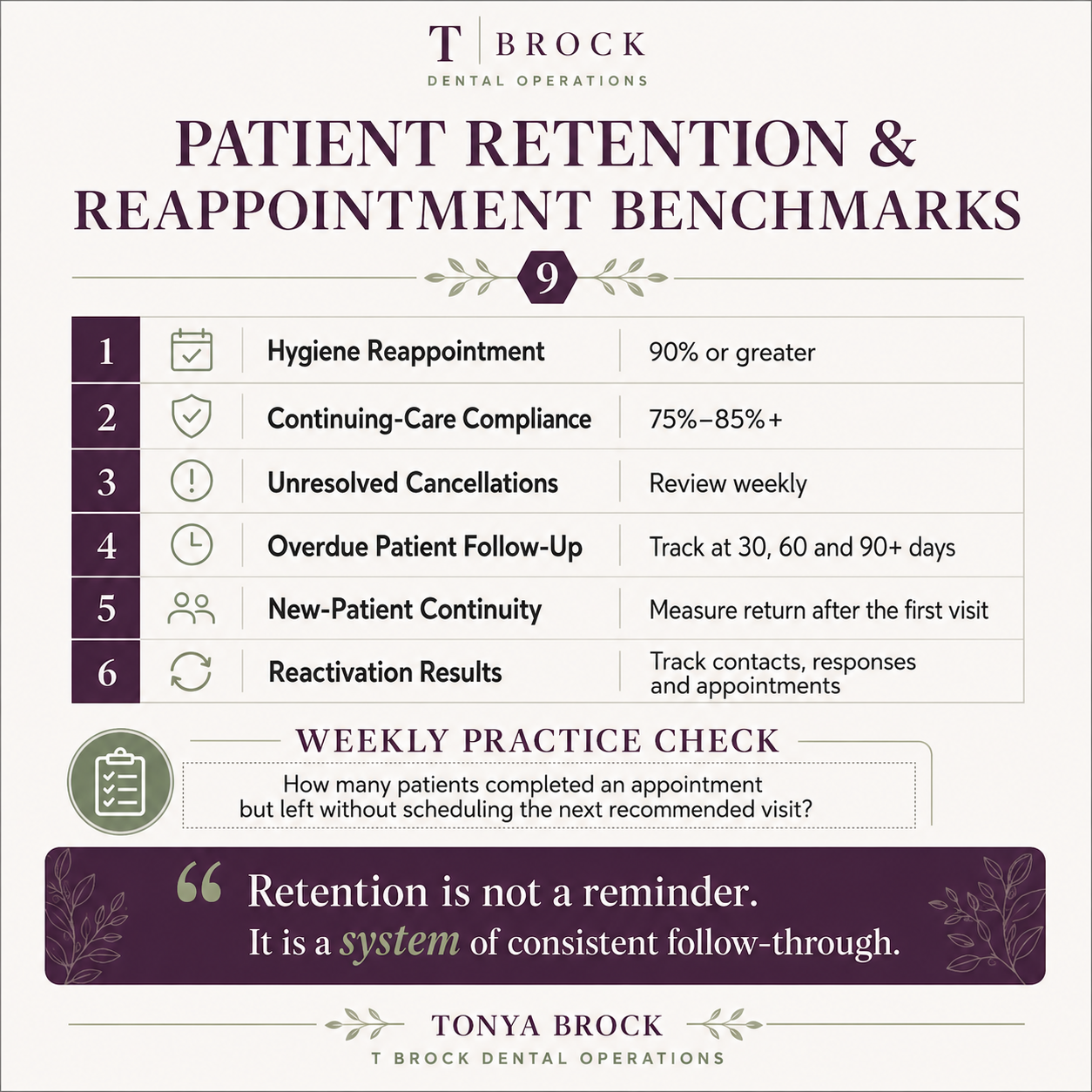
Patient Retention & Reappointment
Is Your Practice Keeping Patients Connected?
A busy schedule can create the appearance of a healthy practice.
But today’s full schedule does not necessarily tell you whether patients are staying connected to the practice, completing recommended care, or returning consistently over time.
Patient retention is not simply a measure of whether patients like the team. It reflects how reliably the practice communicates next steps, schedules continuing care, recovers canceled appointments, and follows up when patients become overdue.
Practices often invest significant time and money attracting new patients while overlooking the patients who have already chosen the practice.
Sustainable growth requires both.
A practice must bring new patients in, but it must also have dependable systems that keep existing patients from quietly slipping away.
Retention Is an Operational Measure
Patients leave practices for many reasons. Some relocate, experience financial changes, change insurance plans, or require care elsewhere.
But many patients do not formally decide to leave.
They simply:
Complete an appointment without scheduling the next one
Cancel and never reschedule
Become overdue for continuing care
Delay recommended treatment
Stop responding to automated reminders
Fall into an inactive-patient report without anyone noticing
No single missed appointment necessarily signals a problem. The operational concern begins when the practice lacks a consistent process for identifying and following those patients.
Retention should therefore be measured through several connected indicators rather than one broad number.
1. Reappointment Before Departure
One of the strongest retention systems is also one of the simplest: helping patients schedule their next recommended visit before they leave the office.
For hygiene patients, a commonly used operational target is a 90% or greater reappointment rate. Industry comparisons published by Henry Schein One showed an average reappointment rate of approximately 77%, while higher-performing practices reached approximately 94%.
A low reappointment rate creates unnecessary work later.
Instead of securing the next visit while the patient is already engaged, the team must rely on future calls, texts, emails, and repeated follow-up attempts.
A consistent reappointment process should include:
Explaining the recommended return interval
Connecting the next appointment to the patient’s health needs
Offering appointment options before checkout is complete
Documenting why a patient chooses not to schedule
Assigning ownership for future follow-up
Avoiding vague instructions such as “call us when you’re ready”
The goal is not to pressure patients. It is to make the next step clear and convenient.
2. Continuing-Care Compliance
A patient may technically remain active in the software while being months overdue for recommended preventive care.
That is why active-patient counts alone can be misleading.
Continuing-care compliance measures whether patients are actually returning according to their recommended interval. Published dental-practice guidance commonly places a healthy recall or continuing-care rate around 75% to 85%, with stronger practices performing above that range.
Practices should regularly review:
Patients currently due
Patients overdue by 30, 60, or 90 days
Patients who have not been seen within the past year
Patients repeatedly contacted without response
Patients incorrectly classified as active
Patients whose recommended interval was never entered
The report is only useful when the practice has a defined response process.
A list containing hundreds of overdue patients is not a recall system. It is merely evidence that the software has been keeping receipts.
3. Cancellation Recovery
A canceled appointment should not disappear from the schedule without a clearly documented next step.
The practice should know:
Why the appointment was canceled
Whether the patient was offered another date
Whether the appointment was rescheduled
Who is responsible for additional contact
When the next follow-up attempt should occur
Whether treatment or continuing care remains incomplete
Cancellation recovery should be tracked separately from general appointment confirmation.
A patient who cancels but immediately reschedules has not been lost. A patient who cancels and receives no further follow-up may quietly become inactive.
Strong practices review unresolved cancellations daily or weekly rather than discovering them months later inside an overdue report.
4. New-Patient Continuity
New-patient volume receives considerable attention, but the first appointment is only the beginning of the relationship.
Practices should also measure whether new patients:
Complete their recommended next visit
Schedule continuing care
Begin accepted treatment
Return after the initial examination
Remain active during the following year
This does not repeat the new-patient intake process. It answers the next question:
After the practice created a strong first impression, did its systems maintain the relationship?
A practice may report healthy new-patient numbers while losing a meaningful portion of those patients after the first appointment.
Tracking continuity helps distinguish temporary patient traffic from sustainable practice growth.
5. Patient Reactivation
Every practice has patients who have fallen outside the normal continuing-care cycle.
Reactivation should not consist of occasionally printing a large report and asking an already overloaded team member to “work on it when there’s time.”
A usable reactivation system should define:
What qualifies a patient as inactive
Which patients should be contacted first
How many contact attempts will be made
Which communication methods will be used
How responses will be documented
When unsuccessful outreach will stop
How successfully reactivated patients will be tracked
Published guidance suggests structured, multichannel reactivation campaigns may recover approximately 8% to 15% of contacted inactive patients within 60 days, although results vary based on the age and accuracy of the patient list, communication method, and team follow-through.
Reactivation is not simply a marketing campaign.
It is the final layer of a broader retention system that should begin before the patient ever becomes inactive.
Operational Benchmarks
Practices should review patient retention and reappointment performance at least monthly.
Recommended measures
MeasureOperational targetHygiene reappointment before departure90% or greaterRecall or continuing-care compliance75%–85% or greaterUnresolved canceled appointmentsReviewed weeklyPatients leaving without a next appointmentTracked weeklyOverdue continuing-care patientsSegmented by 30, 60 and 90+ daysInactive-patient reactivation resultsMeasured by outreach campaignNew patients returning for recommended careTracked by cohort or appointment month
These numbers should be reviewed alongside the practice’s specialty, patient population, recommended recall intervals, payer mix, capacity, and scheduling model.
The purpose is not to chase a percentage without context.
The purpose is to identify where patients are falling out of the system and correct the process before the loss becomes routine.
Common Warning Signs
A patient-retention system may need attention when:
Patients regularly leave without scheduling their next appointment
The team cannot report the hygiene reappointment rate
Canceled appointments remain unresolved
Recall reports contain hundreds of patients with no prioritization
Different team members follow different outreach processes
Automated messages are sent, but responses are not monitored
Patients receive repeated generic reminders without personal follow-up
Inactive patients remain classified as active
New-patient counts are tracked, but second-visit continuity is not
No one clearly owns overdue-patient follow-up
These problems rarely appear dramatic on a single day.
They develop quietly across weeks and months, weakening the schedule, reducing continuity of care, and forcing the practice to replace patients it might have retained.
This Week’s Action
Review the last 20 hygiene patients who completed an appointment.
For each patient, determine:
Did the patient leave with the next appointment scheduled?
Was the recommended return interval documented correctly?
If the patient did not schedule, was the reason recorded?
Was responsibility assigned for follow-up?
Has any follow-up occurred?
Then calculate:
Number of patients reappointed ÷ total completed hygiene visits × 100
Do not attempt to rebuild the entire recall system in one afternoon.
Identify the most common reason patients leave without a future appointment, correct that one breakdown, and give one person clear responsibility for monitoring it.
Final Thought
Patient retention is not created by reminder software alone.
It is built through clear recommendations, consistent reappointment, thoughtful communication, cancellation recovery, and dependable follow-through.
Patients should never have to wonder what comes next, and the practice should never have to guess which patients are quietly slipping away.
When retention systems are strong, patients remain connected, teams spend less time chasing the schedule, and growth becomes more stable.
Grow your practice. Keep your peace.
Tonya Brock
Bringing Order to the Business Side of Dentistry
Tonya Brock is the founder of T Brock Dental Operations, helping independent dental practices strengthen systems, improve accountability, and grow with greater clarity and confidence.