What Broken Appointments Reveal About Your Scheduling System
A cancellation is not always preventable.
Patients become ill. Work schedules change. Children need attention. Transportation falls through. Emergencies happen.
But while the reason for a cancellation may be outside the practice’s control, what happens next should not be.
An unfilled appointment affects more than the day’s production. It interrupts patient care, creates pressure on the team, reduces provider productivity, and may leave needed treatment incomplete.
The strongest dental practices do not treat broken appointments as isolated front-desk problems. They manage them through a clear operational system designed to prevent avoidable cancellations, respond quickly when they occur, recover usable chair time, and keep patients from quietly disappearing.
Why Broken Appointments Matter
A full schedule can create a false sense of security.
The schedule may appear productive several days in advance and still begin falling apart when confirmations are unanswered, patients cancel at the last minute, or appointment gaps cannot be filled quickly.
The American Dental Association has previously reported that patient no-shows and cancellations with less than 24 hours’ notice were the most frequently cited reason practices failed to maintain completely full schedules.
The financial effect matters, but the operational effect is broader.
Repeated broken appointments can contribute to:
Lost provider and hygiene production
Uneven workloads throughout the day
Increased pressure on the scheduling team
Delayed treatment and preventive care
Disrupted production forecasting
Frustration between departments
Patients becoming inactive
Unfinished treatment remaining on the books
Reduced confidence in the schedule
The question is not simply, “How many patients canceled?”
The better question is, “How consistently did the practice respond?”
A reliable cancellation-recovery system has four parts: prevent, respond, recover, and learn.
1. Prevent
Cancellation recovery begins before an appointment is ever broken.
Patients are more likely to keep appointments when they understand the value of the visit, know what to expect, and feel that the time has been intentionally reserved for them.
A strong prevention process may include:
Explaining the purpose and importance of the next visit
Confirming that the patient is comfortable with the selected date and time
Reviewing expected treatment length
Communicating financial expectations before the appointment
Recording the patient’s preferred communication method
Using a consistent reminder sequence
Requiring a response for higher-value or historically unreliable appointments
Providing a clearly written cancellation policy
Documenting recurring scheduling barriers
Automated reminders are helpful, but automation alone does not create commitment.
Certain appointments require personal confirmation—particularly lengthy procedures, high-value treatment, sedation appointments, new-patient visits, and appointments scheduled for patients with a history of late cancellations.
The practice should define which appointments receive an automated reminder and which require direct team contact.
2. Respond
When a patient cancels, the team should not simply remove the appointment and move on.
Every broken appointment should trigger a consistent response.
The scheduling team should document:
Who canceled
When the cancellation occurred
How much notice was provided
The stated reason
The provider and appointment type affected
The amount of chair time released
Whether treatment remains incomplete
Whether the patient rescheduled
Who owns the next follow-up
When that follow-up should occur
The conversation should remain respectful and focused on helping the patient continue care.
A useful response might sound like:
“I understand that today no longer works. Because Dr. Williams reserved this time specifically for your treatment, let’s find another appointment now so your care does not get delayed.”
The goal is not to shame the patient. The goal is to preserve continuity and establish a clear next step.
If the patient cannot reschedule during the call, the account should enter a defined follow-up process rather than being left to memory.
3. Recover
A cancellation-recovery list is most effective when it is current, organized, and specific.
A general list containing hundreds of overdue patients is not a recovery system. It is a database.
The team needs a short, usable list of patients who:
Have requested an earlier appointment
Can arrive with limited notice
Need treatment that fits the available time
Have completed necessary financial arrangements
Have current insurance information
Do not require an outstanding authorization
Are available on particular days or times
Live or work close enough to respond quickly
When an opening occurs, the team should be able to identify appropriate patients without searching through multiple reports or relying on personal memory.
The recovery process should answer:
Who begins working the opening?
How quickly does outreach begin?
Which patients are contacted first?
How many contact attempts are appropriate?
When is the opening communicated to the wider team?
When should the provider consider alternate productive work?
How is the final result documented?
Recovery efforts should begin as soon as the cancellation is received. Waiting until the morning huddle—or until the schedule becomes visibly empty—reduces the likelihood that the time can be recovered.
4. Learn
Broken appointments should be reviewed for patterns, not merely counted.
A practice may discover that cancellations are concentrated around:
Specific days or appointment times
Certain procedures
Long scheduling lead times
Unclear financial expectations
Unconfirmed insurance benefits
One provider or department
New-patient appointments
Hygiene visits scheduled six months in advance
Patients with repeated broken appointments
Appointments that were never personally confirmed
These patterns reveal where the workflow needs attention.
For example, frequent cancellations for high-value procedures may point to unresolved financial concerns rather than poor patient commitment. New-patient no-shows may reflect an intake process that failed to build enough connection before the visit. Hygiene cancellations may indicate that patients were pre-appointed but never fully committed to the selected time.
The schedule is providing operational information. The practice must be willing to examine it.
Operational Benchmark
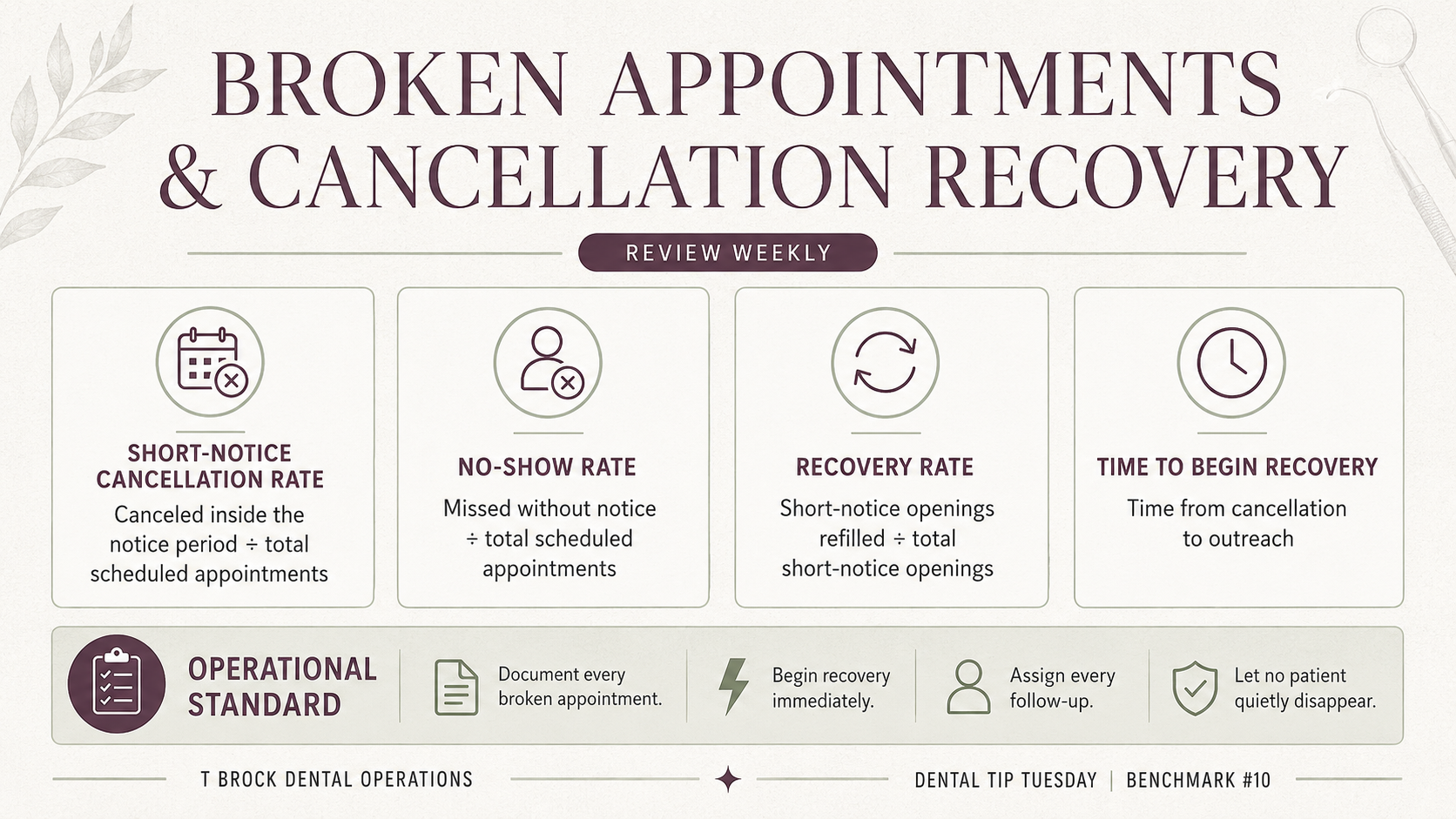
Practices should review broken appointments and schedule recovery every week.
Track:
Short-notice cancellation rate: Appointments canceled inside the practice’s defined notice period divided by total scheduled appointments
No-show rate: Appointments missed without notice divided by total scheduled appointments
Recovery rate: Short-notice openings successfully refilled divided by total short-notice openings
Time to begin recovery: Time between receiving the cancellation and initiating outreach
Rescheduling rate: Patients with broken appointments who secure a new appointment
Unresolved broken appointments: Patients who remain unscheduled after the follow-up process
Recovered production: Production placed back into time that otherwise would have remained open
Repeat broken appointments: Patients with multiple cancellations or no-shows during the review period
There is no single percentage that accurately reflects every specialty, scheduling model, patient population, or market.
The first benchmark is the practice’s own baseline.
The operational goal is to create a consistent downward trend in preventable broken appointments, shorten response time, increase the percentage of openings recovered, and ensure that every affected patient has a documented next step.
A healthy system should also demonstrate that:
Every cancellation receives a documented disposition
Recovery begins immediately
The short-call list is reviewed and maintained
Incomplete treatment is not forgotten
Repeated patterns are discussed with patients appropriately
The team knows who owns each follow-up
Results are reviewed during the weekly operational meeting
The Leadership Question
A broken appointment is not automatically a team failure.
But an opening that receives no timely response, a patient who disappears without follow-up, or a recurring pattern that no one reviews represents an operational gap.
Leaders should not measure the scheduling team solely by whether every chair remains full. They should evaluate whether the practice has a dependable system for responding when the schedule changes.
The objective is not to create a rigid schedule that cannot accommodate real life.
It is to build a responsive one.
When prevention, documentation, recovery, and follow-up work together, the practice protects more than production. It protects continuity of care, team stability, and the patient relationships behind every appointment.
Benchmark Methodology
Operational benchmarks should be interpreted according to each practice’s specialty, provider capacity, appointment mix, payer mix, patient population, and scheduling model. Practices should establish an accurate internal baseline before setting improvement goals. External benchmarks should guide evaluation—not replace practice-specific analysis.
Educational Disclaimer
This material is provided for general educational and operational-planning purposes. It is not legal, financial, clinical, or regulatory advice. Practices should review cancellation policies, patient communications, fees, documentation requirements, and applicable laws with their professional advisers.
Sources
American Dental Association, “Patient Cancellations”
https://www.ada.org/resources/practice/practice-management/cancellations
American Dental Association, “Appointment Confirmations”
https://www.ada.org/resources/practice/practice-management/appointment-confirmations