Is Your Team Trained - or Is the Workflow Truly Standardized?
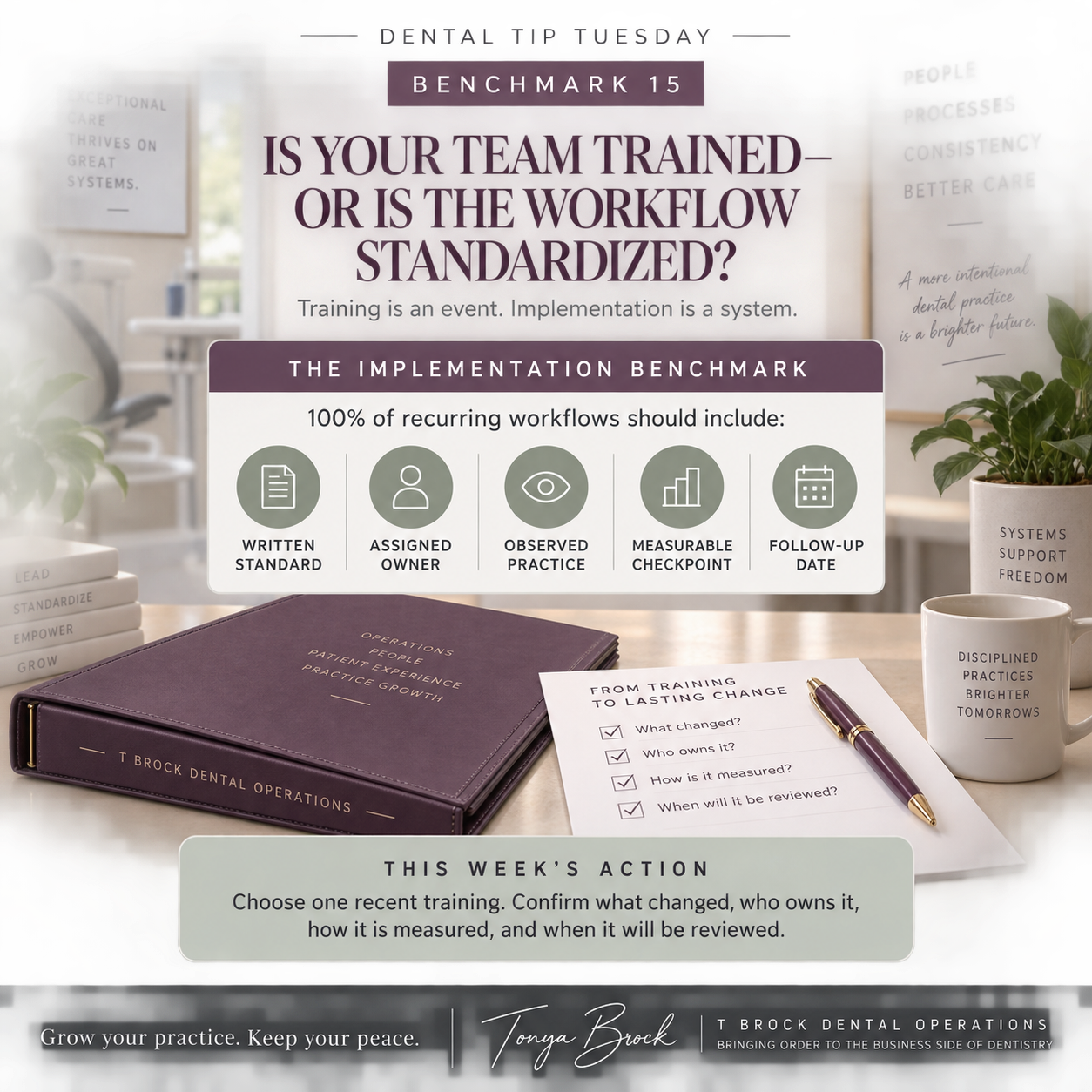
Training is an event. Implementation is a system.
A practice identifies a problem, schedules a meeting, explains the new process, and provides training. Everyone listens. Questions are answered. The team agrees that the change makes sense.
Then the meeting ends.
The following week, the schedule becomes busy. One team member follows the new process exactly. Another remembers only part of it. Someone else returns to the method that feels familiar. Within a month, leadership assumes the training worked while the team quietly operates three different versions of the same workflow.
The practice provided training, but it never managed the implementation.
That distinction matters. Training can introduce knowledge, clarify expectations, and build confidence. It cannot, by itself, confirm that a new behavior is being performed consistently under the pressure of a normal workday.
Recent dental practice guidance makes the same point: education can increase awareness, but sustainable improvement requires shared standards, defined systems, and leadership reinforcement. When the system remains unchanged, the practice may gain knowledge without changing performance.
Attendance Is Not the Same as Adoption
A signed attendance sheet confirms that a team member was present. It does not confirm that the person:
● Understood the new expectation
● Can perform the workflow correctly
● Knows when the workflow applies
● Has the tools and time required to complete it
● Receives feedback when a step is missed
● Continues using the process after the initial training period
This is where many practices become frustrated. Leadership believes the expectation was communicated clearly, while the team experiences uncertainty, competing priorities, or inconsistent reinforcement.
The problem is not always resistance. Often, the implementation structure was never completed.
The Implementation Benchmark
Operational target: 100% of recurring workflows introduced through training should have a written standard, an assigned owner, observed practice, a measurable checkpoint, and a follow-up date.
This is an internal operational benchmark rather than a national industry statistic. Its purpose is to help a practice determine whether training produced a dependable system or only a temporary burst of attention.
1. Written Standard
The workflow should exist somewhere other than a leader’s memory or a team member’s meeting notes.
A useful written standard explains:
● What should happen
● When it should happen
● Who is responsible
● What must be documented
● What requires escalation
● How completion will be confirmed
The document does not need to be complicated. It needs to be clear enough that two trained team members would perform the process in substantially the same way.
2. Assigned Owner
Every implementation needs one person responsible for protecting the process during the adoption period.
Ownership does not mean that person performs every step. It means someone is responsible for noticing whether the workflow is being used, answering questions, identifying barriers, and bringing unresolved issues back to leadership.
When ownership is shared by everyone, it often belongs to no one.
3. Observed Practice
Understanding should be demonstrated, not assumed.
Depending on the workflow, observation may include:
● Reviewing a completed verification
● Listening to a scheduling call
● Auditing a clinical or administrative note
● Watching a handoff between departments
● Following a claim from submission through resolution
● Reviewing how a treatment follow-up was documented
Observation is not intended to embarrass the team. It allows coaching to happen before variation becomes the new normal.
4. Measurable Checkpoint
The practice needs a way to determine whether the change improved performance.
The measure should match the reason for the training. Examples include:
● Percentage of verifications completed before the appointment
● Percentage of unscheduled treatment plans with a documented next action
● Claims submitted with required attachments
● New-patient calls converted to scheduled appointments
● Morning huddles completed on time
● Required handoff fields documented before checkout
If the practice cannot describe what improvement should look like, it cannot determine whether the training worked.
5. Follow-Up Date
Implementation should be reviewed while correction is still possible.
A simple rhythm may include:
● 7 days: Confirm understanding and remove immediate barriers
● 30 days: Audit performance and coach inconsistencies
● 60 days: Review the measure and revise the workflow if necessary
● 90 days: Confirm that the process is stable, assigned, and sustainable
The exact timing may vary, but the follow-up should be scheduled before the training meeting ends.
Why Practices Stop Too Soon
Training feels complete because it has a visible beginning and end. A meeting was held. A document was distributed. A box was checked.
Implementation is less visible. It requires leaders to revisit the subject, observe behavior, review data, coach without shaming, and correct the system when the team encounters a real-world obstacle.
That work is not evidence that the training failed. It is the work that allows training to succeed.
Without follow-up, the practice is left with assumptions:
● Leadership assumes the team adopted the process.
● The team assumes variations are acceptable.
● New employees learn whichever version they happen to observe.
● Inconsistency slowly becomes culture.
This Week’s Action
Choose one training your practice completed within the last 90 days.
Ask four questions:
1. What behavior was expected to change?
2. Who owns the workflow now?
3. How is consistent performance being measured?
4. When will leadership review the result?
If any answer is unclear, the training is not finished. The next step is not necessarily another meeting. The next step is to complete the implementation structure.
Training creates possibility. Follow-up turns that possibility into a repeatable standard.
Grow your practice. Keep your peace.
Tonya Brock
T Brock Dental Operations
Bringing order to the business side of dentistry.
Source
● Gabriele Eva Maycher, Why training alone doesn’t change clinical performance, Oral Health Group, September 10, 2026.
Disclaimer
Benchmarks are intended as general operational guideposts and may need to be adapted for a practice’s size, specialty, staffing model, technology, payer mix, policies, and applicable requirements. This content is educational and is not financial, legal, regulatory, human-resources, or clinical advice.