Treatment Plan Follow-Up
What Happens After the Patient Says, “I Need to Think About It”?
A patient leaves the practice with diagnosed treatment but no appointment.
They may have said:
“I need to check my schedule.”
“I want to talk to my spouse.”
“I need to think about the cost.”
“Let me see what insurance will cover.”
Or simply:
“I’ll call you.”
That moment is not necessarily a rejection of treatment.
But operationally, it creates a responsibility.
What happens next?
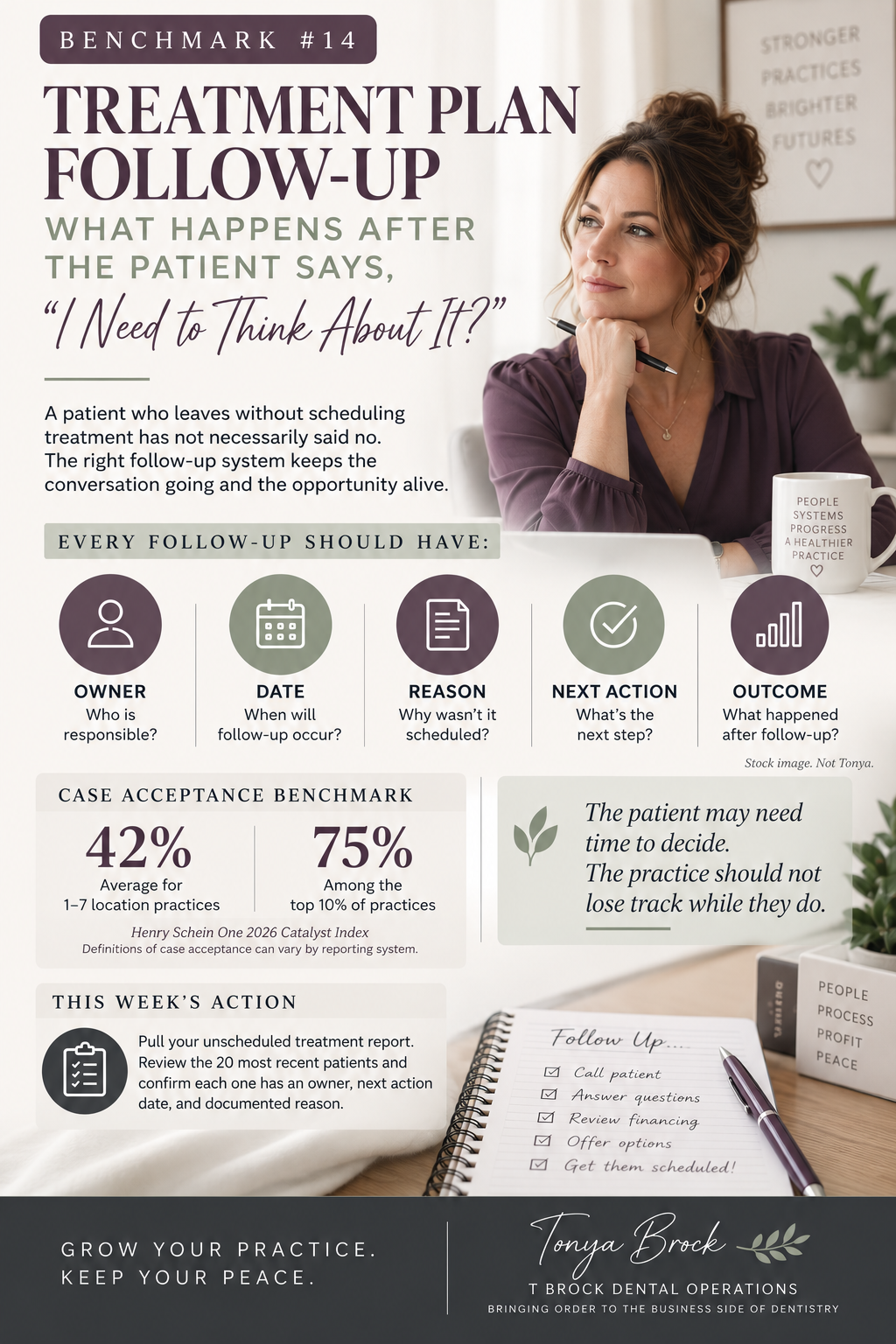
Benchmark #14 Treatment Plan Follow-Up infographic from T Brock Dental Operations showing treatment follow-up benchmarks, ownership, next-action tracking, and case acceptance metrics for dental practices.
Too often, the answer depends on whether someone remembers to run a report, notices the patient on a list, or has enough time between other responsibilities to make a call.
That is not a treatment follow-up system.
A strong practice creates a defined process for patients who leave with recommended care but are not yet ready to schedule.
The goal is not to pressure patients into treatment.
It is to make sure patients understand their options, have an opportunity to ask questions, and do not quietly disappear because the practice failed to follow through.
The Benchmark
Case acceptance provides important context for this conversation.
Henry Schein One's 2026 Catalyst Index reports case acceptance of approximately 42% for the average 1–7 location practice compared with 75% among the top 10%. The ADA has historically suggested practices evaluate whether approximately 75–80% of case presentations are accepted. Different systems may calculate acceptance differently, so practices should use one consistent definition when tracking their own performance.
But case acceptance measures only part of the story.
When treatment is not scheduled immediately, the next operational question becomes:
Does the practice have a reliable process for what happens afterward?
Henry Schein One specifically recommends a structured workflow for outstanding treatment plans and weekly review of unscheduled treatment recommendations.
That is where treatment-plan follow-up begins.
1. “Not Today” Does Not Always Mean “No”
Patients postpone treatment for many legitimate reasons.
They may need:
More information
Financial clarification
Time to consider their options
Coordination with work or family
Insurance information
Financing options
Additional clinical discussion
Time to feel comfortable making the decision
The team's job is not to overcome an objection at all costs.
It is to understand what the patient needs in order to make an informed decision.
A useful follow-up begins before the patient leaves.
Instead of documenting only “patient declined,” the practice should know:
What treatment was recommended?
What did the patient understand?
Why did they choose not to schedule today?
Did they request additional information?
What is the appropriate next step?
Who owns that next step?
When should follow-up occur?
The difference between “declined” and “not ready today” matters.
2. Every Unscheduled Treatment Plan Needs a Next Action
A report is not a workflow.
A list of patients with unscheduled treatment becomes useful only when the practice knows what to do with it.
Each appropriate follow-up should have:
An owner.
A date.
A reason.
A next action.
An outcome.
Without those elements, the practice may repeatedly contact some patients while completely overlooking others.
Ownership is especially important.
When treatment follow-up belongs vaguely to “the front office,” it often belongs to no one.
One team member or clearly defined role should be accountable for making sure the process moves forward.
3. Timing Matters
For extensive treatment requiring another consultation, the ADA advises practices to have patients return within one week to discuss treatment options, noting that too much delay can reduce the likelihood that the patient returns.
Not every unscheduled treatment plan requires another consultation within seven days.
But the principle is important:
Follow-up should be intentional and timely.
Waiting several months to contact a patient about treatment they discussed today weakens continuity.
A practice should establish follow-up intervals appropriate to the treatment and the patient's circumstances.
For example:
Short-term follow-up: questions, financial clarification, scheduling decisions, extensive treatment discussions.
Intermediate follow-up: patients who asked for additional time or need to coordinate benefits, financing, work, or family.
Longer-term follow-up: treatment that remains incomplete after earlier attempts, reviewed according to clinical need and the patient's preferences.
The appropriate timing should be guided by the patient's clinical needs and circumstances—not simply by how old the report is.
4. Follow Up on the Reason, Not Just the Procedure
Generic follow-up sounds like:
“Hi, we're calling because you have unscheduled treatment.”
Useful follow-up remembers the actual conversation.
If the patient's concern was financial, discuss the financial question.
If they needed to speak with a spouse, ask whether additional information would be helpful.
If they were concerned about the procedure, give them an opportunity to speak with the appropriate clinical team member.
If they were waiting for their work schedule, help them explore appointment options.
Patient financing can also play a role when cost is the barrier; the ADA notes that access to financing options can increase case acceptance and reduce the time some patients need to decide about treatment.
The follow-up should continue the conversation—not restart it.
That requires documentation.
5. Track Dollars and Outcomes
Practices should know more than the total value sitting on an unscheduled-treatment report.
They should understand what happens to it.
Track:
Treatment presented
Treatment scheduled
Treatment remaining unscheduled
Dollar value of outstanding treatment
Reason treatment was not scheduled
Follow-up attempts
Follow-up outcomes
Treatment subsequently scheduled
Treatment completed
This creates a much more useful operational picture.
If $200,000 in treatment is sitting unscheduled, the practice has a number.
If leadership knows how old that treatment is, why patients did not schedule, who has been contacted, and how much treatment was recovered through follow-up, the practice has information it can act on.
6. Measure Follow-Up Separately From Case Acceptance
Case acceptance and treatment follow-up are connected, but they are not the same KPI.
Case acceptance asks:
How much recommended treatment moved forward?
Treatment follow-up asks:
What did we do with the treatment that did not?
That distinction prevents this benchmark from becoming another case-acceptance conversation.
A practice can improve the presentation experience and still lose opportunities afterward if there is no organized follow-up.
Likewise, an excellent follow-up system cannot compensate for confusing clinical communication at the beginning.
Both systems matter.
Operational Benchmarks
Practices should establish a consistent treatment-follow-up dashboard rather than relying only on the total unscheduled-treatment balance.
MeasureBenchmark / Review StandardCase acceptance**42% average / 75% top 10%**¹Unscheduled treatment reportReview weeklyFollow-up ownerAssignedNext-action dateDocumentedReason not scheduledDocumentedFollow-up attemptsTrackedTreatment recovered through follow-upTrack monthlyOutstanding treatment agingTrend monthly
¹Henry Schein One 2026 Catalyst Index for 1–7 location practices. Definitions of case acceptance can vary by reporting system.
There is not one credible universal percentage for how much unscheduled treatment every practice should recover through follow-up.
That number will vary significantly based on treatment mix, clinical urgency, patient population, payer mix, financing availability, and how the practice defines accepted treatment.
So do not manufacture a target simply because dashboards look prettier with percentages.
Establish your baseline.
Then improve it.
Common Warning Signs
Your treatment follow-up system may need attention when:
Unscheduled treatment is reviewed only when the schedule becomes light
Follow-up depends on someone remembering
Every unscheduled patient receives the same message
The reason treatment was not scheduled is undocumented
No one owns the follow-up process
Treatment coordinators cannot see previous contact attempts
Patients receive repeated calls from different team members
Large treatment plans sit untouched for months
The practice knows the dollar value of unscheduled treatment but not its age
Case acceptance is tracked, but follow-up outcomes are not
Team members stop following up without documenting why
Patients who have questions have no clear path back to the clinical team
None of these problems requires aggressive selling to correct.
They require organization.
This Week's Action
Pull your current unscheduled-treatment report.
Do not start by calling everyone on it.
Select the 20 most recent appropriate patients who left without scheduling recommended care.
For each patient, answer five questions:
What treatment was recommended?
Why wasn't it scheduled?
Who owns the next contact?
When is the next action due?
What happened after the most recent follow-up?
Then identify how many records are missing one or more of those answers.
That is your starting point.
Before trying to recover every dollar sitting on the report, build a process capable of following one patient correctly from diagnosis to decision.
Then make that process repeatable.
Final Thought
Treatment follow-up should never depend on someone remembering to check a list.
Patients deserve time to make informed decisions about their care.
They also deserve a practice organized enough to remember the conversation.
The strongest follow-up systems do not chase patients.
They preserve continuity.
They make the next step clear, keep responsibility visible, and ensure that diagnosed treatment does not quietly disappear simply because the patient wasn't ready to schedule before leaving the office.
The patient may need time to decide.
The practice should not lose track while they do.
Grow your practice. Keep your peace.
Tonya Brock
Bringing Order to the Business Side of Dentistry
Tonya Brock is the founder of T Brock Dental Operations, helping independent dental practices strengthen systems, improve accountability, and grow with greater clarity and confidence.